This article explores how to build a strategy for product development that identifies and mitigates risk from day one. This helps maintain a more predictable, compliant, and successful launch.
Table of Contents
How to Develop a Risk-Based Strategy for Product Development
In quality-driven industries, relying on hope alone puts a product launch at risk.. Many product strategies fail because they are abstract “whiteboard” concepts. These best-case-scenario plans can potentially break down upon first contact with a supply chain issue, a regulatory hurdle, or a manufacturing flaw.
A practical, effective strategy for product development is not a surefire plan for success. Instead, it’s a rigorous, risk-based framework for managing and mitigating failure.
This article explores how to build a strategy for product development that identifies and mitigates risk from day one. This helps maintain a more predictable, compliant, and successful launch.

An engineer develops a detailed 3D model for a complex medical device, illustrating the “New-Product Strategy Development” stage. This critical phase validates the technical feasibility of a design before significant resources are committed to prototyping.
How Should OEMs Approach a Product Development Strategy?
The first step is to redefine “strategy.” A practical strategy is not a document you write and file away. It is a continuous process of risk management.
A “whiteboard strategy” is often abstract, but an actionable strategy for product development is grounded in how a product will be built, tested, and supported. This approach requires identifying the three primary categories of risk:
- Technical Risk: Can it be built? Will it perform as intended?
- Market Risk: Should it be built? Is there a paying customer and a clear regulatory pathway?
- Manufacturing and Supply Chain Risk: Can it be built reliably, at scale, and on budget?
This risk-based approach, often guided by professional electronic product engineering services, is the best way to create a product plan that survives real-world challenges.
What is the "New-Product Strategy Development" Stage?
This is “Stage 0” of any project and is the most critical risk-mitigation step. This is where you build a funnel to screen new ideas before committing significant R&D spending.
This funnel is the beginning of a formal strategy for product development. Specifically, it is designed to answer two fundamental questions:
Question #1.) What are the main sources of new-product ideas?
Ideas are sourced both internally from sales team feedback, R&D breakthroughs, and market gap analysis. They also come externally from competitor blind spots, customer pain points, and regulatory changes.
Question #2.) How do internal and external screening approaches differ?
Internal screening is the technical risk assessment: “Can we realistically build this?” “Do we have the expertise?” External screening is the market risk assessment: “Even if we can build it, should we?” “What is the regulatory and compliance pathway?”
This external screening is non-negotiable for high-risk fields like new product development for medical devices. A flawed regulatory assumption in a field like biotechnology manufacturing can stop progress before design work even starts.
What are the Key Elements of a Risk-Based Product Strategy?
Once a product idea has been screened and approved, you build the formal strategy. This must be a framework for mitigating the risks identified earlier. The key elements of a risk-based strategy for product development include three main pillars:
- Risk-Based Market and Compliance Plan.
This defines the specific regulatory hurdles (e.g., standards for Renewable Energy Manufacturing) and makes them a core design requirement, not an afterthought.
- Technical and Sourcing Plan.
Mitigates technical and supply chain risk by outlining technology, identifying single-source components, and planning for product lifecycle support to manage obsolescence.
- Manufacturing and Fulfillment Model.
Reduces manufacturing risk by deciding between a high-volume product or a complex, high-mix build better suited for a specialized contract manufacturing company. This aspect influences the product’s entire design philosophy.

What Key Factors Must Be Considered When Executing the Product Strategy?
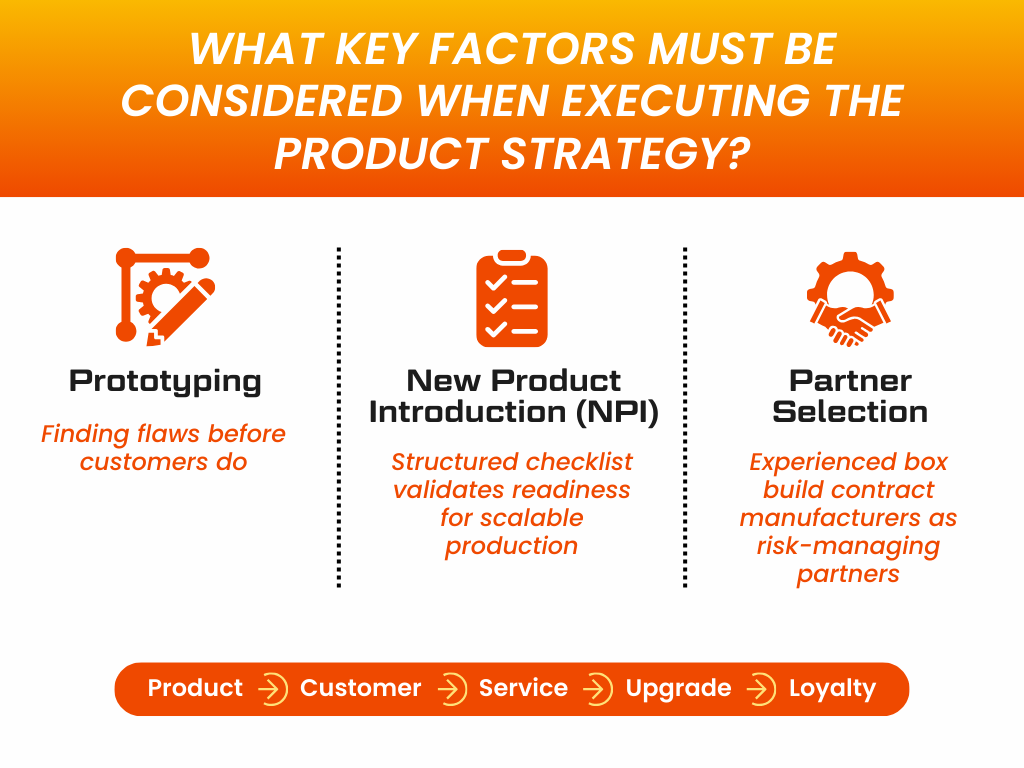
With a strategy for product development already defined, execution becomes a series of targeted risk-mitigation activities. The most critical factors to consider are prototyping, NPI, and partner selection.
Prototyping is not just for creating a sales demo. It is the primary tool for finding and fixing product or design flaws. A comprehensive prototype development services plan is designed to intentionally test the product in controlled settings like thermal, drop, and EMI tests to find weaknesses before customers do.
A formal new product introduction (NPI) process is the practical application of your manufacturing strategy. It is a structured checklist that confirms the supply chain is ready, test fixtures are built, and the design is fully validated for scalable production.
Partner selection is a key risk-transfer strategy. An experienced box build electronic contract manufacturer with a proven track record is not just a vendor. They are your primary partner in managing quality, supply chain, and manufacturing risk.
Build A Manufacturing Strategy Grounded in Reality
A successful strategy for product development is not a simple plan for success. It is a comprehensive, continuous process for identifying, analyzing, and mitigating risk. For quality-driven industries with specialized requirements for electronic product design and development, this is the only strategy that leads to a predictable, compliant, and profitable launch.
MFG One’s professional teams provide end-to-end box build custom manufacturing services for clients across the United States, Canada, the United Kingdom, Mexico, and beyond. Partner with us to build a strategy for product development that is designed for success.
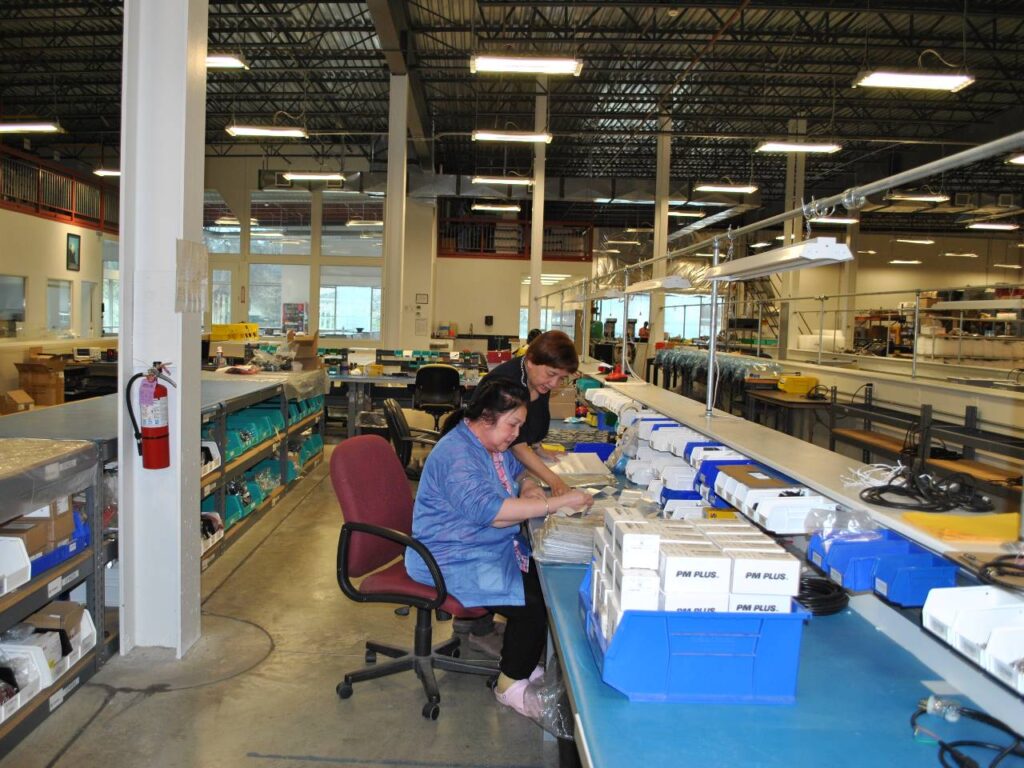
Technicians assemble products on a structured production line, demonstrating the execution of a risk-based manufacturing strategy. This controlled environment confirms that the manufacturing and fulfillment model defined in the planning phase is executed reliably at scale.